Artists you should know · Playlist

Artists you should know / Milan Pilar

TXT

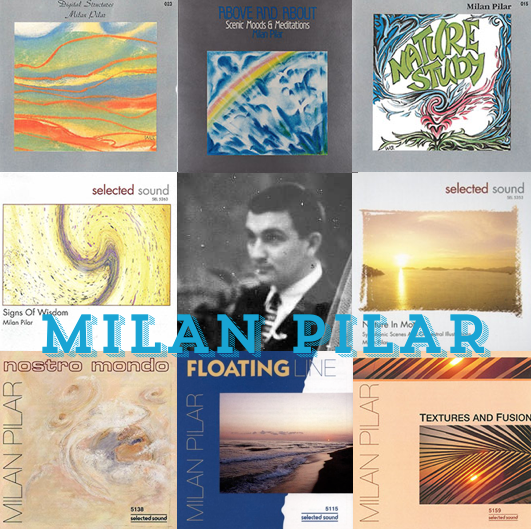
Milan Pilar (born 1934 in Czechoslovakia) is a master of fantasy melodrama. Once he came to use synths, his music became the soundtrack for finding a magic necklace in a pastel-colored forest where anything can happen. Milan created these images in gorgeously exaggerated detail that fills the room with color. He had a talent to induce the most grandiose emotions with impact and genuine tenderness.

Most songs will have sweeping synths and/or strings as a backbone, with digital bells and flutes playing the melodies. Many are wistful and sensitive as if telling you secrets in their hiding place, some carefree and happy, others cinematic and awestruck. No matter the mood, they never lose their Moomin-worthy fantasy charm and elegant expression. It’s a shame Pilar didn’t wind up directly composing for fantasy movies.

He also kept a distinct sound across ten-plus years, something rare for library composers. For instance, his 2003 album Nature In Motion has the virtual same approach as his late-eighties work.

Playlist

I’ve gathered my favorites from across his albums to give a good taster for his style (link above).

1. February  – Pastoral Seasons, Coloursound, 1982

2. Reconciliation – Nature Spoiled and Unspoiled, Coloursound, 1983

3. Above / Extensions – Extensions, Sonoton, 19??

4. Industrial Signature 11 – Industrial, Coloursound, 1986

5. Fountain Idyll – Above And About, Coloursound, 1989

6. Birdlife – Above And About, Coloursound, 1989

7. Digital Structure 2 – Digital Structures, 1990

8. Digital Structure 25 – Digital Structures, 1990

9. Softly As The Summerwind – Nature Study, 1990

10. Wind And Waves – Nature Study, 1990

10. Caravanseral – Nostro Mondo, 1993

12. Irish Autumn – Floating Line, 1993

13. Rainbow – Textures And Fusion, 1994

14. Lost Game Blues – Signs Of Wisdom, 1999

15. Call Of The Mountains – Nature In Motion, 2003

16. Deep Sea Romance – Green Planet, 2004
Artists you should know · Playlist

Artists you should know: Claude Larson

w: txt.png

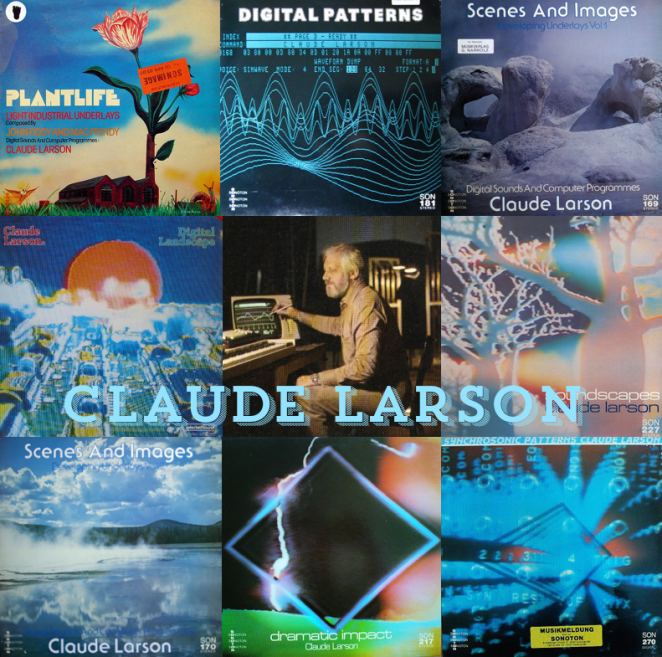
Claude Larson (AKA Carlos Futura, Klaus Netzle) was a frequent contributor to the German music libraries Sonoton and Selected Sound. Many of his albums focused on cinematic backdrops with a tech slant (plants, space, snow, fantasy) and early experiments with digital synths, being one of the first to make extensive use of the Fairlight CMI. As with a lot of 80s library music, his songs were an earlier example of the polished synth-pop/electronic sounds now popular with modern vaporwave/synthwave producers.

Several CL songs have resurfaced on Youtube in the past ten years. Aside from a Fiat LX reissue in 2018, though, they haven’t attracted the same attention as most of Youtube’s other revitalized 70s-80s favorites.

Youtube playlist

I’ve gathered my favorite Larson songs on Youtube with this playlist. Of course, the limits of Youtube’s selection means I can’t make aim for something ‘definitive’, but it make be a good sampler for the curious listener.

Note: I focused on his Sonoton history as most of his Selected Sound albums are rare jingle collections or full of 10+min songs that could disrupt the flow.

1. Sand-Dunes / Environment, 1978

2. Industrial Plants / Surroundings, 1979

3. Helicopter / Synthesis, 1980

4. Marshy Ground / Scenic Sequences, 1980

5. Panorama / Panorama, 1980

6. Biopulse 2 / Scenes And Images – Developing Underlays Vol. 1, 1981

7. Machine Language 2 / Industrial Future, 1981

8. Wolga / Rivers, 1981

9. Harpsi 1 / Digital Patterns, 1982

10. Hardware / High Tech, 198?

11. Blossom / Plantlife, 1983

12. Transformation / Digital Landscape, 1983

13. Dramatic Impact / Dramatic Impact, 1984

14. Autumn Mist Drama / Soundscapes Vol. 1, 1984

15. Wings In The Sky / Wings In The Sky, 1986

16. Aurora / Soundscapes Vol. 2, 1986

17. Synchrosonic / Synchrosonic Patterns, 1987

18. Haunted Clockwork / Synchrosonic Patterns, 1987

19. Alpha-Dream / Euphonia, 1988


hidden treasure

Milan Pilar – Digital Structures / Space And Underwater (1990 / 1993)


library music / progressive electronic

Listen here

At this point I’m convinced this Czech composer was in a home stretch in the late 80s-early 90s. He could do no wrong.

One of my personal music missions is to hear just about every ‘aquatic’ library album I can manage, as it’s almost always a sign of quality. Therefore, I HAD to listen to Milan Pilar’s take on it. It turns out this album began as Digital Structures for the unusual Coloursound label, with no true song titles – “Digital Structure #3”, “#12”, and so on. This  Selected Sound re-issue has a new title plus a true name for every song. In fact, it turns out I’d heard Digital Structures before, and got fooled into thinking this was different. Library labels are weird like that; something unfamiliar will turn out to be another, older album, even from another label!

Even so, I’m glad that I wound up hearing this one again. I picked up on a lot more great tracks this time. Plus, the re-titling helped me tell them apart. Even though SS branded this with space/water themes, it does veer into other moods/imagery at times, like the twinkling fantasy that was the trademark of his also-quality Nature Study. Knowing the album’s origin, this makes some sense.

I’ve written about similar albums before; O’Hearn’s Indigo, Above and About, etc. so many of those same traits apply here. It’s the same fascinating mix of varied moods and soaring synth textures – pads that wash over like shores, glittering arpeggios, warbles, flutters. He really brings out the best in digital synths. The sci-fi/water theme in particular adds some interesting moodier elements to Pilar’s familiar style. It’s the best direction he could’ve taken from his previous albums, and with every song being a mere 1.5 minutes, very digestible. Through their brief length, the songs flourish and establish their grip right on contact.

I especially recommend this if you love a good 80s synth film score. That tension, build and release of a good synth score is here and pulled off in expert fashion. The quality it retains over 43 tracks means this would be one of my favorite scores had an actual movie used it. But, as library music continues to remind me, it turns out some of the best film music doesn’t even wind up getting used.